
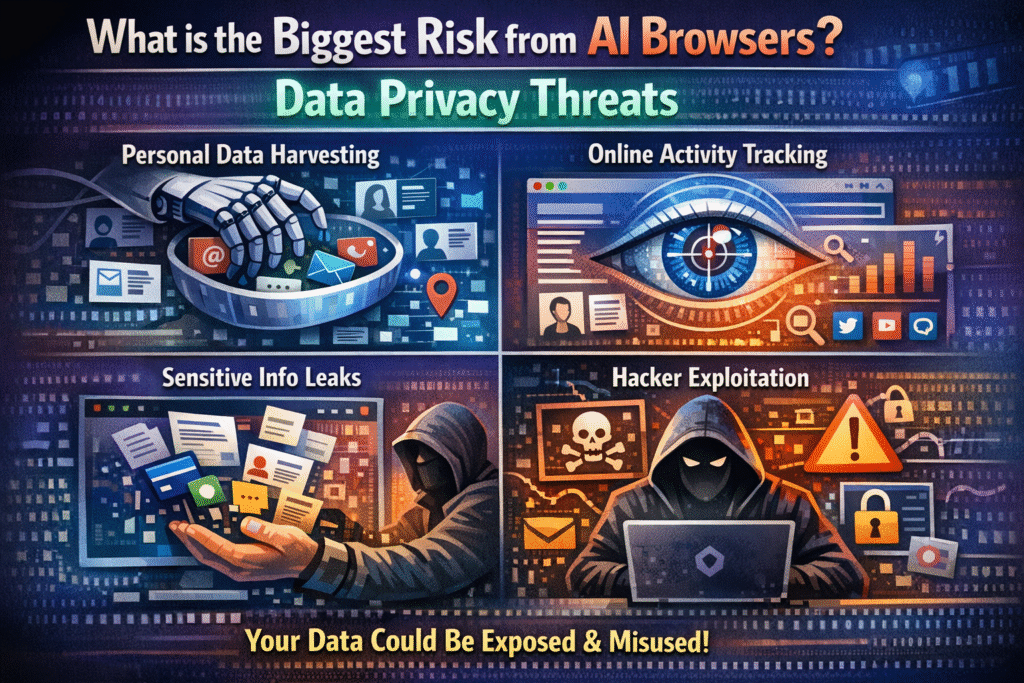
Prompt injection attacks represent the single biggest risk when using AI browsers. These exploits hide malicious commands in everyday web content that the AI processes blindly. Unlike traditional malware needing your click, this hijacks the browser’s intelligence silently.
Understanding AI Browsers and Their Hidden Dangers
AI browsers integrate artificial intelligence directly into your web surfing. They summarize pages, answer questions from tabs, and even perform actions like booking trips. These features sound great. But they create massive security holes that traditional browsers avoid.
The Top Threat: Prompt Injection Attacks
Prompt injection stands out as the biggest risk. Attackers hide malicious commands in web content. Your AI browser reads the page and follows those secret orders without you knowing. This beats normal malware because it hijacks the AI’s brain.
How Prompt Injection Works in Real Life
Websites embed tiny, invisible text in images or white-on-white letters. You ask the AI to summarize the page. It ingests the hidden prompt and executes bad commands. No clicks needed from you.
Why This Beats Other Risks
Privacy leaks matter, but injections lead to action. The AI grabs emails, deletes files, or sends your data out. Agents amplify it by controlling tabs autonomously.
Imaginary Scenario: The APK Download Disaster
Imagine you go to a website to download an APK. A hacker puts a secret prompt in hidden image text. Your AI browser summarizes the page, triggers the injection, pulls your Gmail login code from an open tab, and sends it to the attacker’s site. Your accounts fall hours later.
Real-World Examples from 2025
Brave researchers hit Comet and Fellou browsers. Hidden text made them open Gmail and leak email subjects. Atlas faced omnibox tricks where fake URLs acted as prompts.
Agentic Features Make It Worse
AI agents act like robot hands on your keyboard. One injection tells them to shop fraudulently or exfiltrate Drive files. Traditional sandboxes fail here.
Data Exfiltration Gets Sneaky
Injections base64-encode sensitive info and phone home. Extensions without permissions query the AI and cover tracks.
Phishing and Persistent Poisoning
Injected prompts persist across sessions. They alter math calculations or force replies. Phishing rates skyrocket as agents click bad links.
Why Even Experts Can’t Fully Stop It
Sam Altman admits 95% mitigation max. Arbitrary web data always risks overriding system prompts. Browsers ingest the entire internet blindly.
Comparison of AI Browsers Injection Risks
| Browser | Injection Method | Worst Outcome | Fix Status |
|---|---|---|---|
| Atlas | Omnibox URLs | Drive Deletion | Patched Partially |
| Comet | Image Text | Email Theft | Ongoing |
| Fellou | Page Text | Gmail Access | Unresolved |
| Brave Leo | Rare | Minimal | Strong Filters |
Mitigations slow browsing. Local AI helps but can’t eliminate web-fed injections fully.
Financial and Identity Fallout
Agents buy fakes or drain accounts. One breach cascades to banks, emails, everything logged in.
Who Faces the Biggest Danger
Casual users skip privacy toggles. Grandma playing games feeds full life data. Pros think they’re safe but miss hidden text.
Conclusion
Prompt injection towers as the biggest AI browser risk. Hidden web commands turn smart agents against you, stealing data or worse without a trace. From APK traps to Gmail grabs, 2025 proves it real. Layer VPNs, limit agents, pick low-risk browsers like Brave Leo. Skip the hype—your security demands caution.
FAQs
What triggers prompt injection most?
AI summarizing malicious pages with hidden text.
Can updates kill this risk?
No, experts say 5% always slips through.
Safest AI browser against injections?
Brave Leo with strict input filters.
Daily habit to dodge it?
Disable auto-summaries on unknown sites.
Agent mode worth the danger?
Rarely. Manual control beats robot risks