
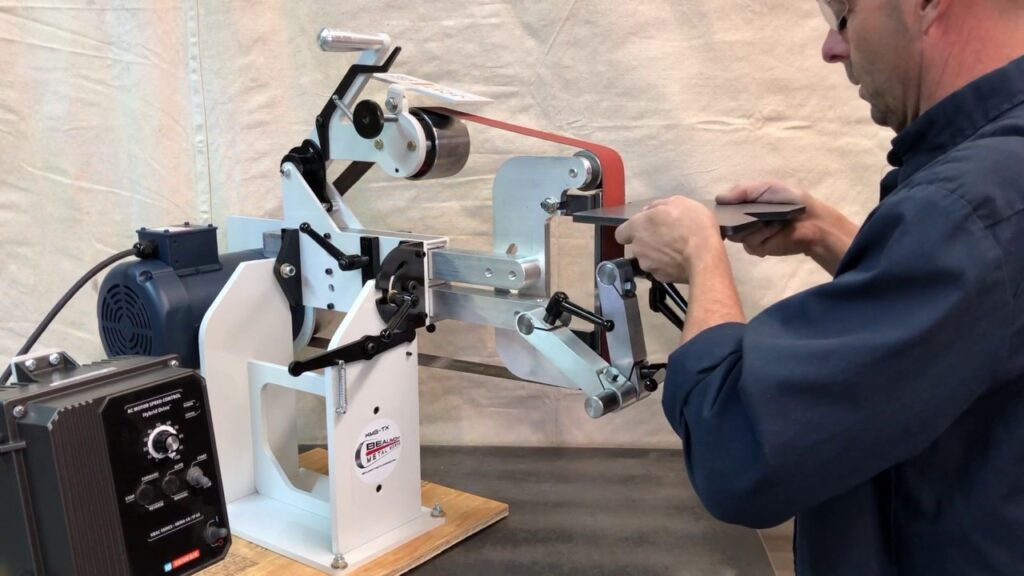
The choice of grinding equipment can make the difference between precision and mediocrity, efficiency and downtime, profitability and waste. While off-the-shelf metal grinders are a common entry point for many shops, custom metal grinders are increasingly recognized as the superior choice where performance, longevity, and adaptability matter most.
This article explores the reasons custom metal grinders outperform off-the-shelf solutions, examining technical advantages, operational impact, economic considerations, and real-world usability.
1. Tailored to Specific Applications
Off-the-shelf grinders are designed to serve a broad range of general grinding tasks. Manufacturers must balance features and price, resulting in a one-size-fits-many approach.
In contrast, custom metal grinders are engineered around your exact application:
Material type: Stainless steel, Inconel, tool steels, aluminum alloys — each material interacts differently with abrasives, speed, and force. A custom grinder accounts for these variables.
Workpiece size and geometry: Whether you’re grinding long shafts, intricate contours, or heavy billets, the machine’s frame, spindle configuration, and feed systems can be designed to fit.
Tolerance requirements: High-precision industries like aerospace or medical devices demand tolerances that generic machines struggle to hit consistently.
By tailoring design parameters to your process, custom grinders produce:
✔ higher accuracy
✔ fewer rejects
✔ better surface finish
✔ faster cycle times
This tailored performance can be the difference between profit and loss in precision-critical sectors.
2. Superior Build Quality and Materials
Cost constraints often limit the build quality of off-the-shelf grinders. Manufacturers rely on standard components and budget materials to hit competitive price points. While this is perfectly adequate for low-volume or hobby usage, industrial applications quickly expose these limitations.
Custom grinders, on the other hand, are built to specification:
Heavy-duty frames and castings minimize vibration and deflection.
Precision-ground machine components ensure repeatability.
Industrial-grade bearings, drives, and controls extend machine life and uptime.
The result is a machine that doesn’t just grind well on day one — it stays accurate and reliable over thousands of operating hours.
3. Optimized Ergonomics and Productivity
Off-the-shelf grinding machines are built to generic standards of usability. But every shop operator knows that the right ergonomic layout — controls, access doors, work holding, and loading/unloading areas — can significantly impact both productivity and safety.
Custom grinders address these concerns directly:
Ergonomic control placement reduces operator fatigue and error.
Custom workholding and fixturing accelerates setup times.
Integrated automation options like loading arms, conveyors, or robotic cells eliminate repetitive manual work and enable lights-out operation.
By optimizing for the actual people and workflows in your shop, custom grinders boost throughput without compromising quality.
4. Integration with Digital Systems and Automation
Modern manufacturing increasingly relies on digital integration — machine data, process monitoring, predictive maintenance, and Industry 4.0 connectivity.
Off-the-shelf grinders often include standard control packages that lack comprehensive data output or advanced harmonization with enterprise systems.
Custom solutions, by contrast, can be:
- Fully networked with MES/ERP systems
- Equipped with sensors for real-time condition monitoring
- Configured for remote diagnostics
Programmed with intelligent feeds and speeds based on part and material
This level of integration empowers data-driven decision-making, lowers downtime, and future-proofs your equipment investment.
5. Adaptability and Future Scalability
A machine bought off the rack is, by its nature, a fixed configuration. If your product mix changes — perhaps new materials, tighter tolerances, or different part sizes — the machine may no longer be suitable without expensive retrofits or replacement.
Custom grinders are designed with adaptability in mind:
- Modular components that can be reconfigured
- Upgrade paths for spindles, controls, or automation
- Expansion provisions for future tooling or sensors
This means your grinder evolves with your business rather than forcing you into early replacement cycles.
6. Better Total Cost of Ownership (TCO)
At first glance, off-the-shelf grinders often seem more affordable due to a lower upfront purchase price. However, this view can be misleading once you factor in total cost of ownership:
- Frequent maintenance and part replacements
- Lower throughput and higher scrap rates
- Longer setups and unplanned downtime
- Inability to handle higher-value jobs
Custom grinders — though higher in initial cost — deliver savings over time through reduced waste, higher uptime, and increased productivity.
An apples-to-apples evaluation almost always shows custom solutions winning on:
✔ Parts per hour
✔ Machine availability
✔ Consistent quality
✔ Long-term reliability
7. Enhanced Safety and Compliance
Grinding operations pose real safety risks: flying particles, exposed abrasives, coolant overspray, noise, and operator strain.
Generic machines are designed to meet baseline regulatory requirements, but they may lack specialized safeguards required in certain environments.
Custom grinders can incorporate:
- Full enclosures with controlled extraction
- Advanced guarding and interlocks
- Dust and coolant containment systems
- Noise reduction treatments
- Ergonomic load/unload features
For industries under strict compliance standards (e.g., aerospace, medical, defense), this means reduced risk and fewer regulator-driven delays or fines.
8. Collaborative Engineering and Support
Off-the-shelf products are typically designed with limited feedback loops from individual customers. Support comes through general help desks and standard procedures.
With custom grinders, you get:
- Direct engineering collaboration
- Prototypes and iterative design reviews
- Training specific to your process
- Long-term service agreements tailored to your needs
This partnership approach results in a machine that truly fits your operation and a vendor relationship that supports you long after installation.
9. Real-World Performance That Matters
The practical differences between custom and off-the-shelf grinding solutions show up in:
- Repeatability from batch to batch
- Reduced need for secondary finishing
- Higher yield on premium materials
- Faster turnaround for urgent jobs
- Smooth integration into your production flow
In short, custom grinders make it easier, and often cheaper, to produce better parts faster.
Conclusion
Grinding might seem like a straightforward manufacturing step, but in high-performance industries, every micron matters. Custom metal grinders are not just premium equipment, they are strategic assets that deliver measurable returns across quality, productivity, safety, and flexibility.
For businesses ready to compete on precision, efficiency, and innovation, custom metal grinders don’t just outperform off-the-shelf solutions — they transform what’s possible in your shop.